
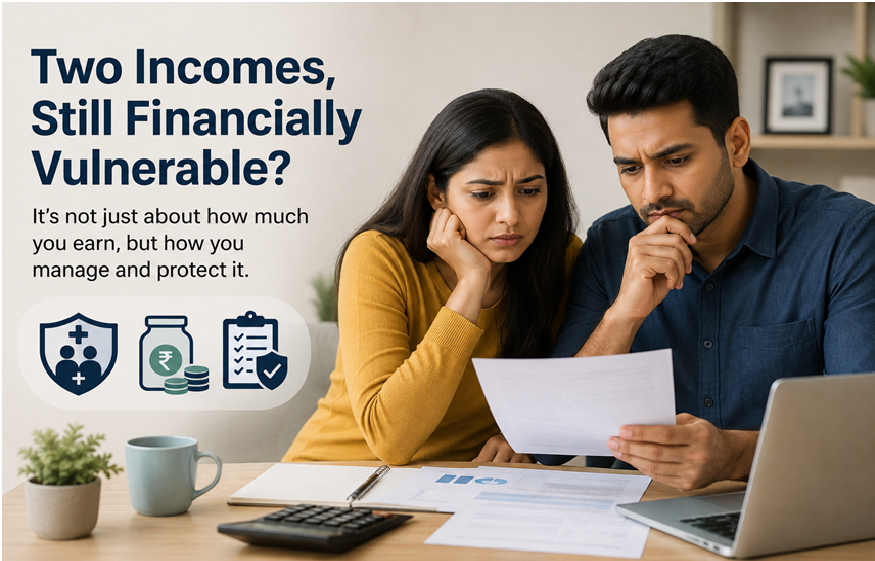
It’s a common assumption: two incomes means twice the security. In reality, many dual-income households in India live paycheck to paycheck, carry significant debt, and have little to no emergency buffer despite earning well above the national average. It’s not the amount of money a couple makes that makes them vulnerable. It’s how that money is structured, spent, and protected.
Income grows with lifestyle, but safety nets don’t. As household earnings increase, spending on rent, cars, dining, and subscriptions often increases in tandem, sometimes faster. With pay rises, couples tend to upgrade their lifestyle, but not necessarily their savings rate or insurance cover. The result is a family that looks financially comfortable on paper but has almost no cushion if one stream of income is disrupted.
The hidden danger is the reliance on both salaries. Most two-income families plan their EMIs, rent, and fixed expenses on the assumption that both salaries will always come in on time. Because the fixed obligations were sized for combined income, not just one partner’s income, a job loss, a medical event, or even a temporary pay cut for one partner can throw the whole budget into deficit.
No financial transparency in the joint
The vast majority of couples keep their accounts, cards, and investments separate with little shared visibility of the whole financial picture. That fragmentation produces holes such as duplicate insurance, unused subscriptions, or a missing emergency fund that go undetected until a crisis spurs a full audit.
Cheap but underinsured
Many dual-income households can afford adequate life and health cover but are often underinsured, believing the dual income provides adequate cover. This is an expensive assumption, as a health emergency or the death of an income earner can derail years of financial planning for the surviving household.
No emergency fund in place
Most financial planners suggest saving three to six months’ worth of expenses for emergencies. Many two-income couples skip this step entirely, relying instead on credit cards or informal borrowing when something goes wrong, which adds interest costs on top of the original shock.
How couples can work through these issues
- Create a shared view of joint income, expenses, debt, and goals even when accounts are separate.
- Fixed commitments (rent, EMIs) are computed on the basis of the lower of the two incomes (not total).
- Make sure each of you has sufficient term life and health insurance for yourself.
- Set up a joint emergency fund goal and make automatic contributions from both incomes.
- Review periodically as income, family size, or responsibilities change.
In dual-income households, financial vulnerability is rarely about earning too little but rather about not measuring financial health as a couple. The first step to understanding your real financial exposure is an objective health check, not a gut feeling that “we’re doing fine because we both work.
The financial wellness assessment on AirPay Money gives couples a clear, structured view of their combined finances, highlighting savings gaps, protection shortfalls, and areas that need attention before a crisis forces the conversation.